Western Cape organic waste legislation and policy are changing the way large shopping centres need to think about food and other biodegradable waste.
For property managers, facilities teams and retail operators, the issue is no longer simply whether contractors collect waste efficiently. Instead, the bigger question is how much organic material the property can prevent, separate and divert before landfill becomes the final option.
This is particularly relevant in the Western Cape, where the provincial waste-management framework continues to work towards 100% organic-waste diversion from landfill by 2027.
However, that does not mean every shopping centre faces one identical blanket requirement.
National waste legislation, provincial policy, municipal by-laws, waste-service arrangements, licences, contracts and the activities taking place on site can all influence a particular property’s obligations.
Therefore, large shopping centres should not wait for one piece of legislation to dictate every step. A stronger approach is to understand the direction in which waste management is moving and build better organic-waste systems now.
No single rule sets out the complete organic-waste obligation for every supermarket, restaurant, food court or shopping centre in the Western Cape.
Instead, South African waste management operates through a combination of legislation, regulations, norms and standards, provincial planning, municipal requirements and site-specific conditions.
At national level, the waste-management hierarchy places waste avoidance and reduction ahead of reuse, recycling, recovery and disposal.
Meanwhile, the Western Cape has made organic-waste diversion a specific provincial priority.
The province established targets to divert 50% of organic waste from landfill by 2022 and 100% by 2027.
The province did not reach the earlier 50% target. Provincial reporting showed an organic-waste diversion rate of approximately 30% for 2023, which means significant additional diversion is still needed to move towards the 2027 objective.
As a result, organic waste remains an important planning issue for municipalities, businesses and other large waste generators.
The 100% organic-waste diversion target provides a clear direction for the Western Cape.
However, property managers should not interpret a provincial target as proof that every shopping centre faces precisely the same legal obligation on the same date.
Municipalities play an important role in implementation through their Integrated Waste Management Plans and Organic Waste Diversion Plans.
In addition, local by-laws, waste-collection arrangements and infrastructure can differ between municipalities.
Property managers should therefore check the specific requirements that apply to their sites rather than relying only on a general interpretation of the provincial target.
At the same time, the broader direction is difficult to ignore. Large generators of food and organic waste should increasingly plan around diversion rather than assume landfill disposal will remain the default long-term route.
A shopping centre is not simply a collection of unrelated tenants when it comes to back-of-house waste.
Restaurants, supermarkets, coffee shops, takeaways and food retailers may each generate their own waste. However, much of that material eventually enters shared infrastructure.
As soon as waste enters a shared system, property-level management becomes important.
Individual tenants may remain responsible for separating food waste correctly inside their own operations. Meanwhile, centre management needs visibility of whether the wider system supports that behaviour.
For example, one tenant may separate correctly while another places packaging or general rubbish into the same organic-waste stream. That contamination can compromise the wider process.
Therefore, successful organic-waste diversion in a shopping centre cannot rest with tenants alone.
A practical system clearly defines who takes responsibility for each stage.
The exact division will vary between properties. Importantly, each site should document responsibilities rather than leave them to assumption.
For example, a policy that simply tells tenants to “manage their waste responsibly” may achieve very little if nobody checks what happens when that waste reaches the shared back-of-house area.
Organic-waste diversion becomes much harder after staff mix food waste with general rubbish.
Therefore, the best opportunity to protect the organic stream is where staff generate the waste.
In a restaurant, that may be the preparation area or dish-return station. In a supermarket, it may include fresh produce, bakery, deli and prepared-food departments.
Clear containers, practical signage and staff training all help. However, the system must also work during peak trading periods.
A procedure that works on a quiet Tuesday morning but collapses during a busy Saturday lunch service is not a reliable waste system.
For that reason, shopping centres should make separation at source part of normal operations rather than treat it as an occasional sustainability exercise.
Correct separation gives food waste more treatment and recovery options.
However, mixing it with plastic packaging, disposable gloves, general rubbish or other contaminants can reduce those options.
Management should therefore measure and investigate contamination rather than simply accept it.
If the same problem keeps appearing, management can ask:
In this way, contamination becomes useful management information rather than an unexplained problem.
Large retail sites should know more about their organic waste than how many times a truck collects it.
Once a site separates the organic stream, management can start measuring it independently.
For example, management can track:
As a result, management gains a stronger basis for planning and can have more useful discussions with tenants, waste contractors and treatment providers.
Without measurement, waste management remains largely reactive.
Large shopping centres do not need to wait until the 2027 target date before reviewing their organic-waste systems.
Instead, a sensible starting point is to establish what currently happens from the moment staff generate food waste until it reaches its final destination.
Management can ask:
Together, these questions create a useful baseline before management makes equipment or infrastructure decisions.
Large shopping centres often think about waste in terms of collection capacity.
However, collection does not necessarily need to be the first intervention.
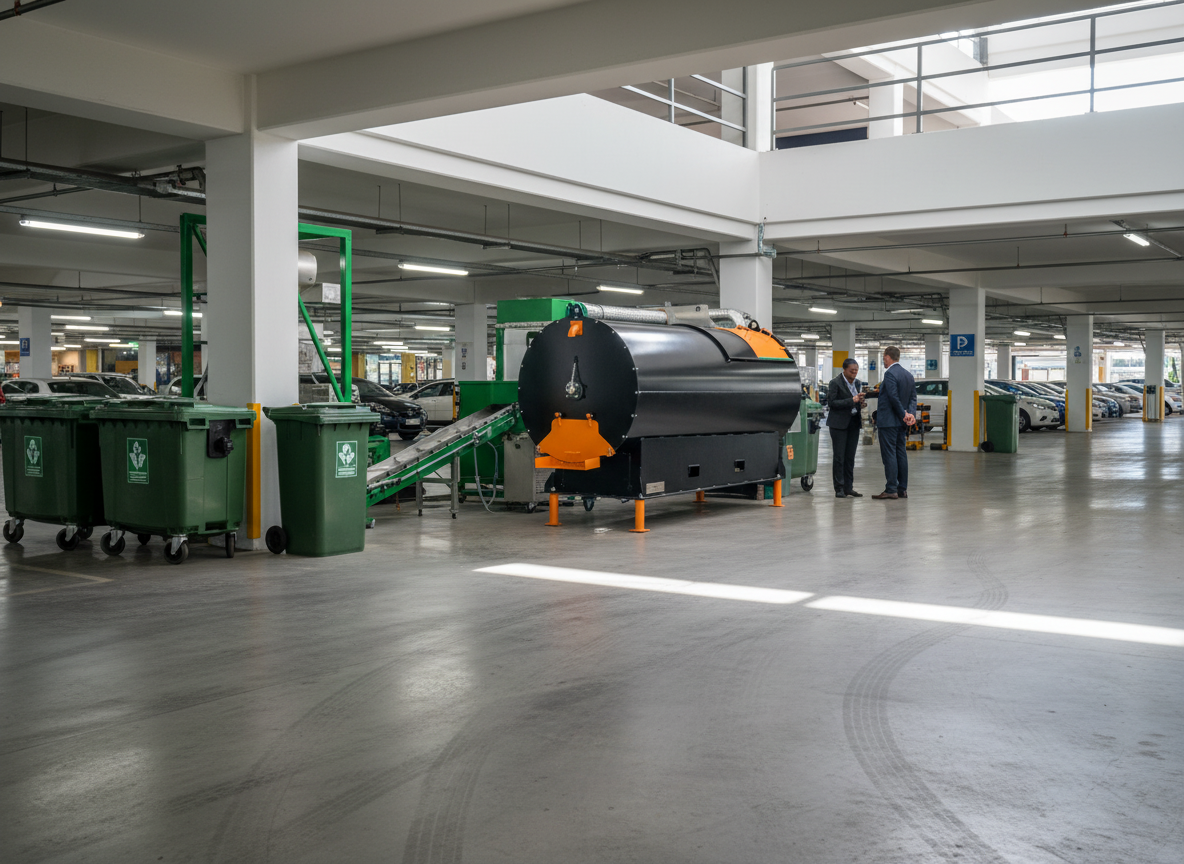
Where suitable, onsite food-waste treatment allows a property to manage organic material before deciding what genuinely needs to leave the site.
This changes the conversation from:
“How frequently do we need this collected?”
to:
“What can we separate and treat before transport is required?”
That distinction matters because untreated food waste contains significant moisture and continues to break down while it waits for collection.
Therefore, treating suitable material at source can reduce dependence on transporting untreated food waste and give management greater control over the organic stream.
Different retail properties generate different volumes of food waste.
For example, a neighbourhood shopping centre with several food tenants will not necessarily require the same system as a large regional mall with supermarkets, restaurants and a busy food court.
Earth Probiotic provides different food-waste treatment options according to the scale and layout of the site.
Commercial Bokashi may suit smaller commercial food-waste streams, while other sites may use Earth Cube systems for lower-volume onsite treatment.
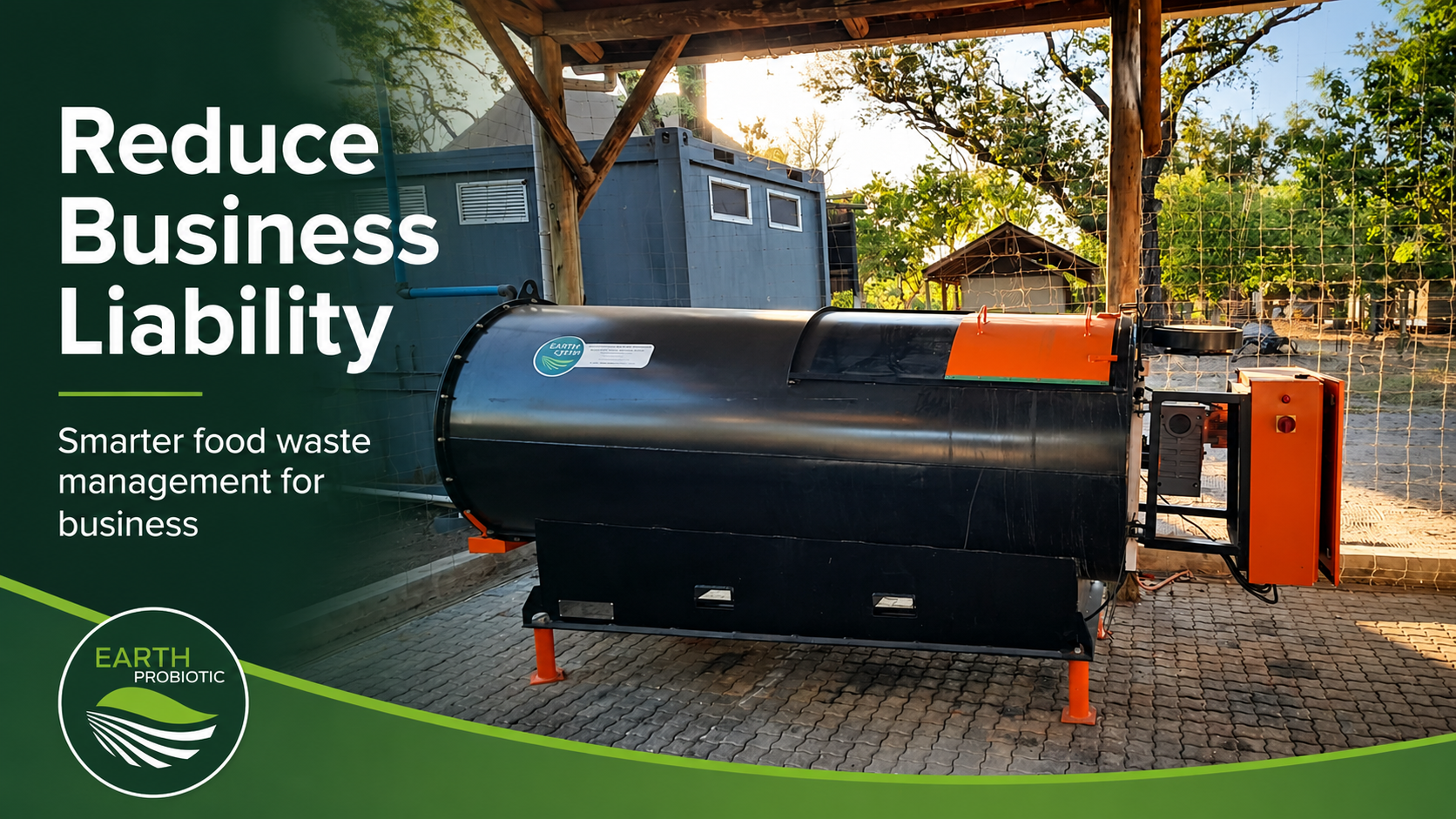
Higher-volume retail environments may require an automated in-vessel system such as the Earth Cycler.
Importantly, the waste stream should guide the solution. Treatment capacity, infrastructure, available space, operating patterns and the planned destination of the treated material all need consideration.
Explore Earth Probiotic’s Food Waste Solutions for more information about available treatment options.
This distinction is important when discussing organic-waste diversion.
Food-waste treatment forms one stage in a wider pathway.
For example, Bokashi ferments food waste inside the treatment container. It does not produce finished compost at that stage.
Other treatment methods may also produce material that needs additional maturation or processing, depending on the method and intended use.
Earth Probiotic therefore operates as the treatment and system partner at the front end of the pathway.
The company helps businesses separate, treat and stabilise suitable organic waste and prepare it for an appropriate next stage.
As a result, businesses should not assume that material becomes a finished or marketable product simply because it has passed through equipment.
Shopping centres should not treat Western Cape organic waste legislation and policy as something to address only when a deadline arrives.
Instead, a more resilient approach builds organic-waste management into normal property operations.
By taking this approach, a property places itself in a stronger position as landfill-diversion expectations continue to develop.
The question is not simply whether a shopping centre can prove that contractors collect its bins.
Instead, management should be able to explain what organic waste the property generates, how teams separate it, what happens to it and why that pathway is appropriate.
For large Western Cape shopping centres, that is becoming an increasingly important part of responsible waste governance.
Organic-waste diversion does not begin at landfill. It begins inside the supermarket, restaurant, takeaway or food court where the waste originates.
From there, every decision affects what remains possible.
Separate it correctly. Measure it. Treat suitable material at the appropriate scale. Plan what happens next. Then decide what genuinely needs to be transported.
Earth Probiotic works with food-generating businesses and commercial properties to assess food-waste streams and identify practical at-source treatment solutions suited to the site.
Explore Earth Probiotic’s commercial food-waste solutions to learn more.