Supermarket and food court waste management becomes more complicated as volumes, tenants and trading hours increase.
A single restaurant may control what happens in its own kitchen. A supermarket or shopping centre, however, may need to manage food preparation areas, fresh-produce departments, restaurants, takeaways, shared waste rooms, cleaning teams, contractors and several different waste streams at the same time.
That makes supermarket food waste management more than a collection problem.
The system needs to work from the point where organic waste is generated through to separation, internal movement, measurement, treatment and the appropriate onward pathway.
In the Western Cape, this is becoming increasingly relevant as the province works towards its policy target of diverting organic waste from landfill.
For supermarkets, shopping centres and food courts, the practical question is therefore not simply who collects the waste.
It is:
How do we control a high-volume organic waste stream before it becomes mixed waste?
High food-waste volumes are only part of the challenge.
The greater difficulty is often the number of points at which waste enters the system.
A supermarket may generate organic waste from produce preparation, bakery operations, prepared meals, expired stock and other food-handling areas. A food court adds multiple restaurants and takeaways, each with its own staff, service periods and kitchen routines.
Once these individual streams enter shared back-of-house areas, small weaknesses can quickly become larger problems.
One tenant may separate food waste correctly while another places plastic packaging into the same container. Cleaning staff may follow a different procedure. A bin may move from one department without anyone recording where it came from.
By the time the material reaches the central waste area, management may have very little visibility of what is actually inside it.
This is why scale requires structure.
The larger the site, the less effective an informal waste system becomes.
The cleanest opportunity to separate food waste exists where staff generate it.
In a supermarket, that may be a fresh-produce preparation area, bakery, deli or other food-handling department. In a food court, it may be inside each tenant kitchen.
If food scraps enter a mixed general-waste bin at that point, recovering a clean organic stream later becomes much harder.
Separation at source therefore needs to be part of the daily operating procedure rather than something that happens once waste reaches the loading bay.
Containers should be positioned where food waste is actually produced, and signage should reflect the material generated in that work area.
Staff also need clear instructions about what belongs in the organic-waste stream and what does not.
For example, food scraps may belong in the designated organic container while plastic film, disposable gloves, cutlery and other packaging belong elsewhere.
The objective is simple: make the correct action easier than the incorrect one.
Contamination should not simply disappear into the next stage of the process.
If staff repeatedly find packaging or general rubbish in an organic-waste container, the site needs to identify where the problem starts.
That could mean unclear signage, inconsistent staff training, poor bin placement or a procedure that does not work during peak service.
Finding the source of the contamination is far more useful than accepting it as inevitable.
Multi-tenant sites introduce another question:
Who is responsible for the food-waste system?
The answer cannot simply be “everyone”. When responsibility is too broad, practical tasks can fall between tenants, cleaning teams, facilities managers and waste contractors.
A stronger system identifies who is responsible at each stage.
Property management may oversee the wider system while individual tenants remain responsible for correct separation inside their own kitchens.
The exact model will vary from site to site. What matters is that the responsibilities are documented and understood.
Waste-room performance can reveal whether the separation system is working.
If untreated food waste remains mixed with general waste, the shared waste area may carry more moisture, weight and putrescible material than necessary.
That can increase pressure on housekeeping routines, collection schedules and the people responsible for maintaining the area.
Removing food waste from the general stream changes what remains in those bins.
It can also make it easier to understand whether residual waste volumes are genuinely reducing.
Compaction can help businesses manage the volume of appropriate residual waste, but compressing mixed waste does not solve the underlying food-waste problem.
If substantial organic material enters the general-waste stream, the business is still mixing a potentially treatable material with waste destined for another pathway.
Separation should therefore happen before the residual waste reaches the compactor.
Untreated food waste continues to break down while it waits for collection.
For a busy retail site, this means waste-management planning should consider not only container capacity, but also how long organic material remains onsite and what happens during weekends, holidays and peak trading periods.
Treating suitable food waste earlier can reduce reliance on storing untreated organic material until the next collection.
A large site cannot manage what it does not measure.
Collection invoices may show how often waste leaves the property, but they do not necessarily explain which departments or tenants generated it.
Separating the food-waste stream creates an opportunity to measure it independently.
This can help management understand:
Over time, that information can support more informed operational decisions.
A supermarket may identify recurring losses in a particular department. A food court may see that waste volumes change significantly during weekends or holidays.
Measurement moves the conversation away from assumptions.
The Western Cape has made organic-waste diversion from landfill a significant policy priority.
The Western Cape Government’s current planning documents continue to work towards a target of 100% organic-waste diversion from landfill by 2027. Municipalities are required to develop and implement Organic Waste Diversion Plans as part of this broader provincial direction.
You can read the province’s current waste-management information on the Western Cape Government Waste Management page.
This does not mean that every supermarket or restaurant operates under an identical direct requirement.
Waste obligations depend on factors including the applicable municipality, waste services, licence conditions, contracts and the activities taking place at a particular site.
However, the direction is clear.
Businesses generating significant volumes of organic waste should be planning for greater diversion rather than assuming landfill disposal will remain the default long-term solution.
South Africa’s National Waste Management Strategy also places waste prevention, reduction, reuse, recycling and recovery ahead of disposal in the waste hierarchy.
For some high-volume sites, onsite food waste treatment can change the entire waste-management model.
Instead of treating collection as the first intervention, the business separates and manages suitable organic material before deciding what needs to leave the site.
This can reduce dependence on transporting untreated food waste and provide much better visibility of the organic stream.
However, the treatment system needs to match the site’s actual waste profile.
Management should understand volumes, operating patterns, available space, infrastructure, staff capacity and the intended destination of treated material before selecting equipment.
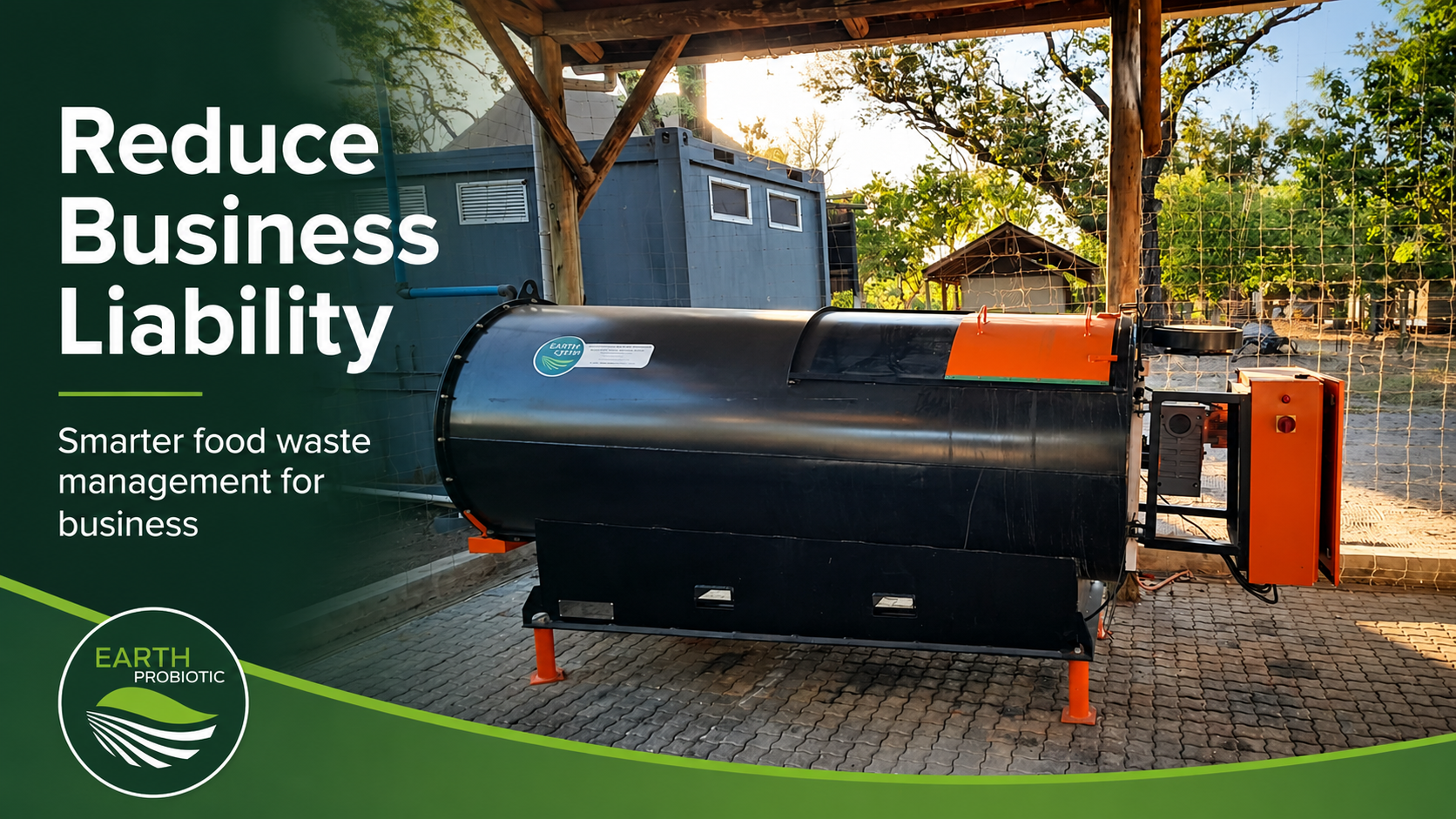
Earth Probiotic’s supermarket and mall food-waste solutions include the Earth Cycler, a locally manufactured automated in-vessel system designed for larger food-waste volumes.
The current Earth Cycler range includes systems with food-waste processing capacities of approximately five tonnes and ten tonnes per month.
The system records organic-waste inputs and can provide measurement data, giving management greater visibility of how much food waste enters the treatment process.
Earth Cyclers have already been installed at shopping-centre sites in South Africa, giving Earth Probiotic practical experience with high-volume retail environments.
Not every site requires a large in-vessel system.
Earth Probiotic also provides commercial Bokashi and Earth Cube options for lower-volume or distributed food-waste streams.
The current Food Waste Solutions range includes commercial Bokashi for suitable smaller commercial kitchens and canteens, as well as Earth Cube units for lower-volume onsite treatment.
The appropriate solution should follow the waste assessment rather than the other way around.
Onsite treatment does not remove the need for responsible downstream planning.
Treated organic material still needs an appropriate destination.
Depending on the treatment method, inputs and stage of the process, further maturation or processing may be required before the material is suitable for its intended use.
Earth Probiotic should therefore be understood as the enabling treatment and system partner at the front end of the pathway.
The objective is to separate suitable organic material, treat it appropriately and prepare it for the next responsible stage.
Circular value does not come from simply moving food waste through a machine.
It comes from managing the full pathway.
Supermarkets and food courts cannot rely on a single bin, sign or waste contractor to solve a complex organic-waste stream.
The strongest systems connect several operational decisions:
For Western Cape supermarkets, shopping centres and food courts, these decisions will become increasingly important as organic-waste diversion moves further into mainstream waste planning.
The question is no longer only how quickly waste can leave the property.
It is how much control the business can establish before that waste needs to move at all.
Separate at source. Measure the stream. Treat according to scale. Reduce before you transport.
Explore Earth Probiotic’s food-waste solutions for supermarkets and malls, or visit the Food Waste Solutions page to compare available treatment options.